 fa
 tr
 ar


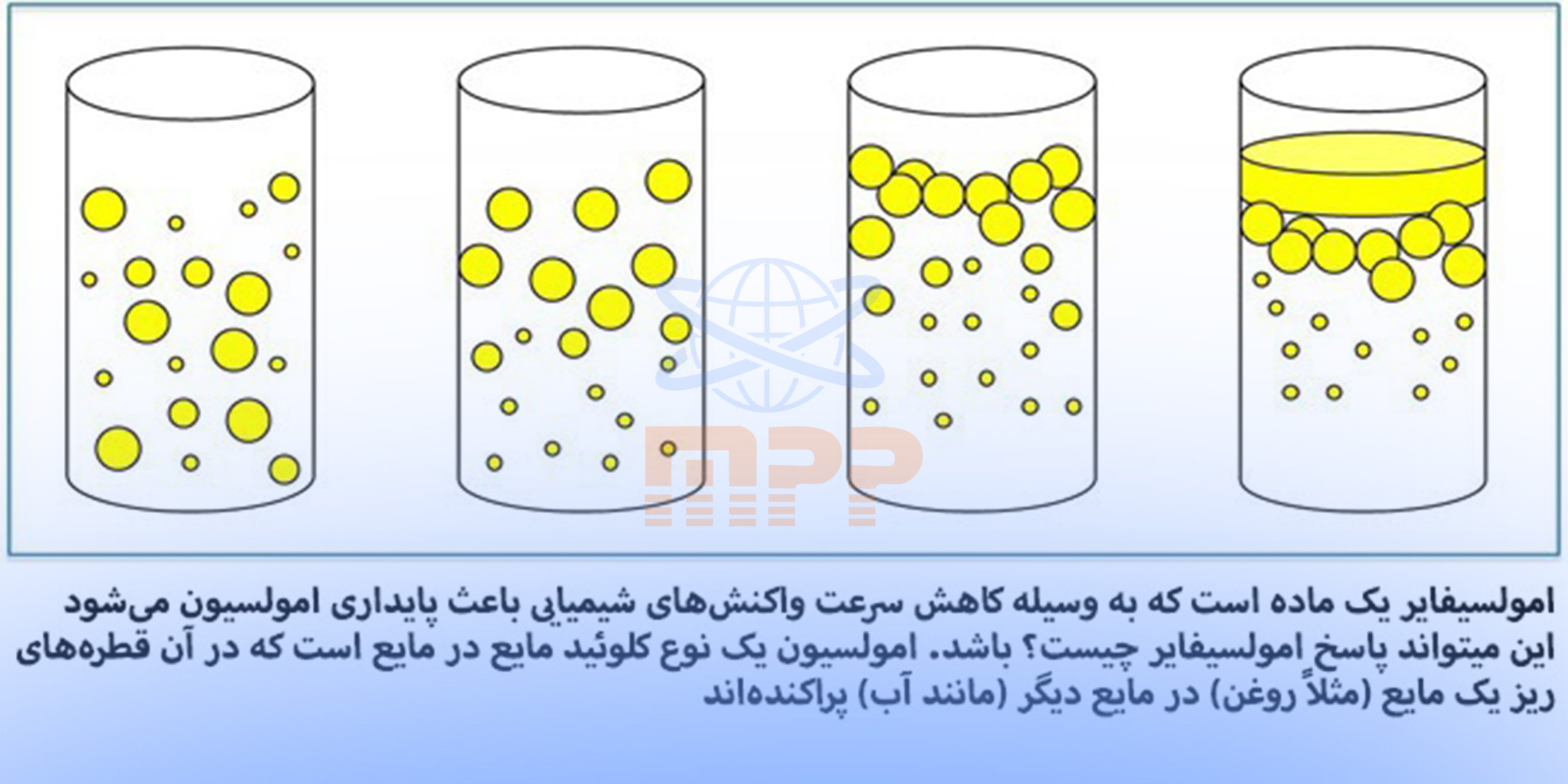
What is an emulsifier?
An emulsifier is a substance that lowers the surface tension between water and oil and so allows an emulsion to form and stay stable. An emulsion is a liquid-in-liquid colloid in which tiny droplets of one liquid (for example oil) are dispersed in another (such as water). Emulsions are divided into two types: water-in-oil (W/O) and oil-in-water (O/W). In a W/O emulsion, water droplets are dispersed in the oil phase (as in butter and margarine), while in an O/W emulsion, oil droplets are dispersed in the water phase (as in milk and mayonnaise). Emulsifiers, especially surfactants (surface-active agents), are widely used in the food industry; egg yolk lecithin, mustard, soy lecithin and sodium stearoyl lactylate (E481) are common examples.
When buying emulsifiers and emulsions, choose reliable suppliers with consistent quality. For paraffin emulsions and related products, you can contact Mehr Gostar’s sales team for prices and specifications.
Types of emulsifiers
Emulsifiers used in food production can come from natural sources such as plants and animals, or be synthetic substances with a structure similar to natural ones. For example, lecithin (E322), widely used in chocolate, can be obtained from soybeans (oil), eggs, liver, peanuts and wheat germ. Pectin (E440), used mainly as a gelling agent and stabiliser, occurs naturally in fruits such as apples and pears. Around 60 additives in the group “emulsifiers, stabilisers, gelling agents and thickeners” are currently authorised in the European Union.
| E number | Substance / group | Examples of foods |
|---|---|---|
| E322 | Lecithin | Chocolate |
| E407 | Carrageenan | Flavoured milk, iced coffee, dairy ice cream and frozen desserts, chilled desserts, cream |
| E412 | Guar gum | Dairy products, salads, soy-based products, water-based frozen desserts, fillings and sandwich spreads |
| E415 | Xanthan gum | Mayonnaise, fillings and sandwich spreads, salad products, sauces and dressings |
| E432–436 | Polysorbates | Bakery products, milk and cream, ice cream, desserts, confectionery |
| E460–469 | Celluloses, including carboxymethyl cellulose | Sweeteners, meal replacements and other drinks, meat substitutes, vitamin and diet supplements, water ices, soft drinks and syrups |
| E471 | Mono- and diglycerides of fatty acids | Dairy ice cream and frozen yoghurt, margarine, cakes, pastries, frozen desserts, sandwiches and packaged foods |
| E473–474 | Sucrose esters and sucroglycerides | Chewing gum, plant-based ice cream and frozen yoghurt, gummies, jellies, plant-based drinks, snacks, cereals and energy bars |
| E475 | Polyglycerol esters of fatty acids | Cakes, pastries and sweet goods, sweet biscuits, baking ingredients and mixes, frozen desserts |
| E476 | Polyglycerol polyricinoleate (PGPR) | Chocolate products, frozen dairy products, margarine and other blends |
| E481–482 | Stearoyl lactylates | Bakery goods, breakfast cereals, desserts, bread |
| E491–495 | Sorbitan esters | Cakes, pastries and sweet goods, baking ingredients and mixes, chocolate products |
Uses of emulsifiers
Emulsifiers are used very widely across the food industry, including:
- Bread: emulsifiers give bread better structure and more volume. Dough strengtheners improve the structure and texture, while dough softeners keep bread softer and fresher for longer.
- Chocolate: emulsifiers give chocolate the right consistency and help prevent bloom (a whitish surface).
- Ice cream: they create a smoother texture and better stability during freezing and melting.
- Margarine: emulsifiers give margarine the necessary firmness, texture and taste.
- Processed meat: processed meats are made by salting, cooking, smoking and fermenting for better flavour or preservation, and emulsifiers stabilise the emulsion and spread the fat finely throughout the product.
In low-fat meat products, additives such as mono- and diglycerides of fatty acids (E471) and citric acid esters (E472c) are used to improve flavour and palatability. Emulsifiers are also used in many other products such as desserts, syrups and baked goods.
Emulsifiers in cosmetics
In cosmetics and personal care products, emulsifiers help combine immiscible liquids into an emulsion. By lowering the surface tension between water-loving and oil-loving ingredients, they create fine, dispersed mixtures and keep the emulsion stable, which is essential for creams and lotions.
Natural emulsifiers
Natural emulsifiers include proteins, phospholipids (such as lecithin) and egg yolk. Emulsifiers can also be classified by whether they ionise in water: ionic (anionic or cationic) or non-ionic. In food applications, an important issue with ionic emulsifiers is their sensitivity to pH: they may react with other food ingredients and form clumps that reduce their emulsifying power.
How emulsifiers work
Emulsifiers lead to two different types of emulsion: they can disperse oil droplets in water or, conversely, water droplets in oil. An emulsion has a continuous phase and a dispersed phase; in an oil-in-water emulsion, water is the continuous phase and oil the dispersed phase. Low-fat foods, ice cream, margarine, salad dressings and many creamy sauces are kept as stable emulsions thanks to these additives, which are also widely used in peanut butter and chocolate. Emulsifiers also improve the texture of baked goods by helping the dough hold gas, and in products such as pasta they increase resistance to overcooking.
Common emulsifiers in food production include lecithin (soy, sunflower and egg yolk), mustard, mono- and diglycerides, polysorbates and sucrose esters; substances such as carrageenan and guar gum are used as thickeners and stabilisers alongside emulsifiers. Lecithin from egg yolk is one of the oldest and most powerful animal-derived emulsifiers, used to stabilise oil in water-based emulsions such as mayonnaise.
The HLB value and choosing the right emulsifier
The most important criterion for choosing an emulsifier is its HLB (hydrophilic–lipophilic balance), usually a number between 0 and 20:
| HLB range | Behaviour | Examples |
|---|---|---|
| 3 to 6 | Water-in-oil (W/O) emulsifier | Sorbitan esters (Spans), monoglycerides, PGPR |
| 7 to 9 | Wetting agent | Some modified lecithins |
| 8 to 18 | Oil-in-water (O/W) emulsifier | Polysorbates (Tweens), high-HLB sucrose esters |
| 13 to 15 | Detergent | Detergent surfactants |
In practice, combining a low-HLB and a high-HLB emulsifier usually gives a more stable emulsion.
Emulsifiers in non-food industries
Emulsifiers are not limited to food and cosmetics. In industry they are used to make paraffin emulsions and slack wax emulsions (for waterproofing MDF and particleboard), bitumen emulsions, metalworking fluids, agricultural pesticides, water-based paints and polishes. In these applications anionic, cationic or non-ionic emulsifiers are chosen depending on the resin and process.
Safety of emulsifiers
The safety of food emulsifiers is reviewed by regulators such as the US FDA and EFSA, and many are listed as generally recognised as safe (GRAS). However, some studies have raised concerns that very high intake may be linked to weight gain, inflammation and metabolic syndrome, and because emulsifiers act partly like detergents, heavy consumption through processed foods may affect the gut microbiota; this is still being researched. Regulatory reviews have concluded that emulsifiers are safe at the authorised levels.
Conclusion
Emulsifiers are a group of additives that create and maintain emulsions and are used in food production and many other industries. They come from natural sources such as eggs and vegetable oils or are made synthetically, and they help produce products with the right texture and consistency and long-term stability. Although there are some concerns about excessive intake, regulatory reviews show that normal use at authorised levels is safe. For emulsions and petroleum jelly, you can contact Mehr Gostar Paraffin Refining.
Frequently asked questions
What is an emulsifier?
An emulsifier is a substance that lowers the surface tension between water and oil, helping an emulsion form and stay stable and preventing the phases from separating.
What are the types of emulsifiers?
By origin, emulsifiers are natural (such as lecithin) or synthetic (such as polysorbates); by charge, they are ionic (anionic and cationic) or non-ionic.
What is the HLB value?
A number between 0 and 20 that shows how water-loving an emulsifier is; low HLB suits water-in-oil emulsions and high HLB suits oil-in-water emulsions.
Are food emulsifiers safe?
Authorised emulsifiers are considered safe at the levels set by bodies such as the FDA and EFSA, although the effect of high intake of some of them on the gut microbiome is still being researched.
Related articles and products
Submit a comment
No comments found


