 fa
 tr
 ar


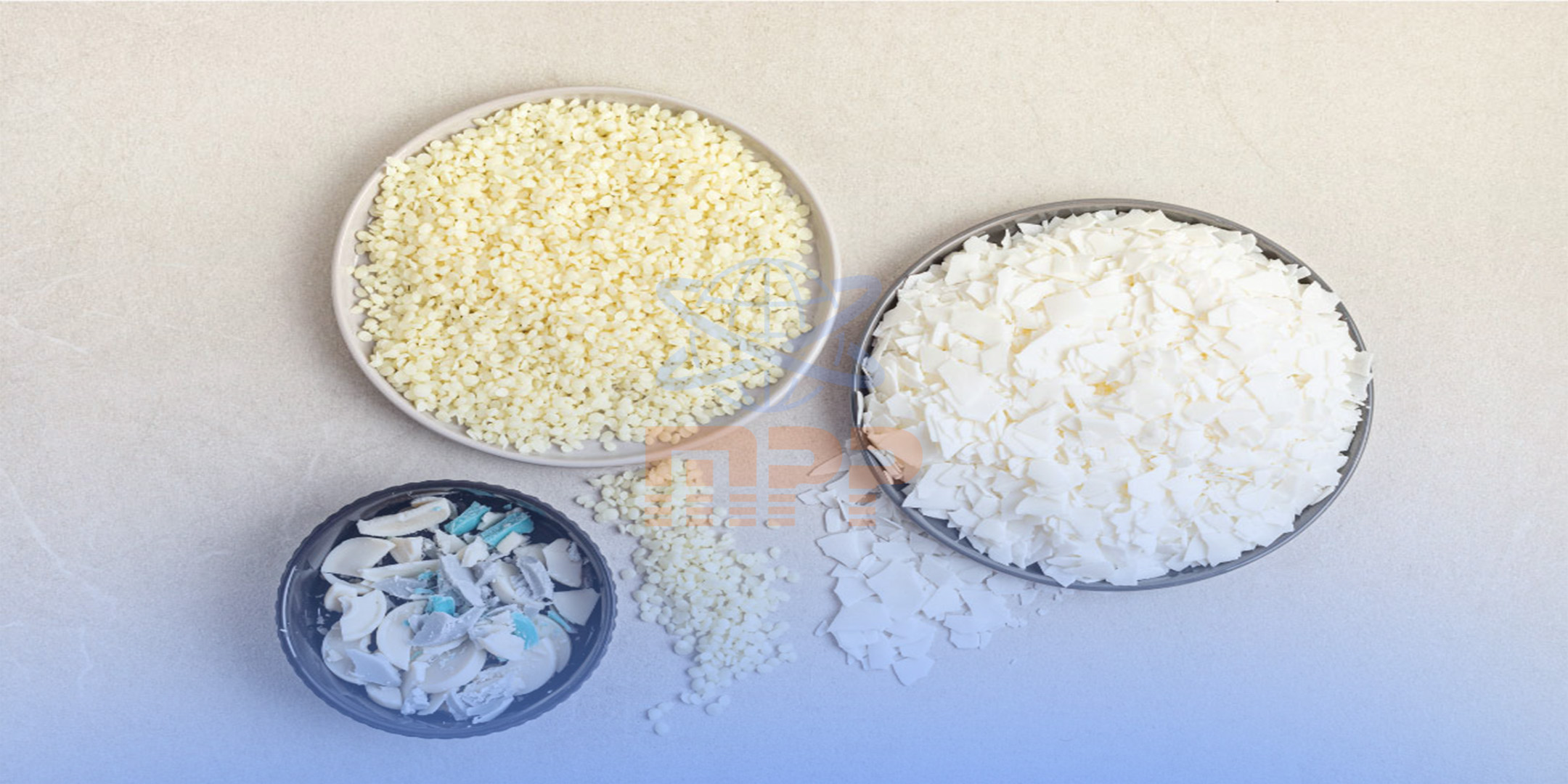
Solid paraffin is a white to milky, odourless wax obtained by refining petroleum waxes and used in candles, matches, packaging, rubber, wood panels and the food, cosmetic and pharmaceutical industries. Types of solid paraffin are classified by three main criteria: oil content (degree of refining), melting point and crystal structure. In this article we introduce all types of solid paraffin with the specifications and uses of each, so you can choose the right grade for your needs.
What is solid paraffin?
Chemically, paraffins are alkanes: saturated hydrocarbons whose carbon atoms are joined only by single bonds. Solid paraffin is a mixture of long-chain alkanes (roughly 20 to 40 carbon atoms) that is solid and waxy at room temperature. It is made from the waxes separated in lube oil refineries (slack wax) after de-oiling and refining; we explain the full process in our article on the paraffin production process.
Types of solid paraffin by oil content
Oil content is the most important quality criterion for solid paraffin. The lower the oil content, the whiter, harder, less odorous and more expensive the paraffin.
| Type | Approx. oil content | Appearance | Common uses |
|---|---|---|---|
| Fully refined paraffin | Below 0.5% | White, clear when molten, odourless | Food, pharmaceutical and cosmetic industries, premium candles |
| Semi-refined paraffin | About 0.5–1.5% | White to milky | Candles, matches, packaging, paper |
| Higher-oil paraffin (market grades 1–3, 3–5 and 5–8%) | 1–8% | Milky to yellow, mild odour | Economy candles, rubber, MDF, emulsions |
| Slack wax | Usually 5–35% | Yellow to brown | Wax emulsions, MDF, matches, raw material for paraffin |
In the Iranian market, paraffins are often named by their oil content, for example “1–3% paraffin”. “Crystal paraffin” usually refers to low-oil and fully refined grades with a coarse crystalline texture and glossy appearance.
Types of solid paraffin by melting point
Solid paraffin is produced in different melting point grades. Common grades are 52–54, 54–56, 56–58, 58–60, 60–62 and 62–64 °C. The melting point is measured by ASTM D87, or the congealing point by ASTM D938.
- Low grades (52–56 °C): softer; suitable for container candles, emulsions and some packaging uses.
- Medium grades (56–60 °C): the most widely used grades for general candle making, matches and paper.
- High grades (60–64 °C): harder and more heat-resistant; suitable for moulded and pillar candles and hot climates.
Macrocrystalline paraffin and microcrystalline wax
By crystal structure, petroleum waxes fall into two groups:
- Macrocrystalline paraffin (ordinary paraffin): obtained from light and medium oil cuts, with large, plate-like crystals; it is hard and brittle and usually melts between 46 and 68 °C. Most solid paraffin on the market is of this type.
- Microcrystalline wax: produced from very heavy cuts and vacuum distillation residue, with very fine crystals; it is flexible, slightly tacky and has a higher melting point (usually about 60–90 °C). It is used in cosmetics, cheese coatings, hot-melt adhesives, rubber (as ozone protection) and blended with paraffin to make candles more flexible.
Types of solid paraffin by application
Industrial solid paraffin
Industrial paraffin is usually semi-refined or higher-oil and is used in match making, water-resistant paper and board, rubber and tyres, wood panels (MDF and particleboard), cables and insulation, anti-rust coatings and wax emulsions. In these applications, price and reliable supply matter more than perfect whiteness.
Cosmetic-grade solid paraffin
Fully refined paraffin is used in cosmetics (such as creams, lipsticks, depilatory wax and skin care products) and in paraffin therapy. Paraffin forms a protective layer on the skin that reduces moisture loss and transfers heat gently.
Food-grade solid paraffin
Food-grade paraffin is fully refined and hydrofinished and must comply with food standards (such as US FDA regulations for petroleum waxes in contact with food). Its uses include cheese coatings, fruit and vegetable coatings, chewing gum, food packaging and waxed paper.
Crystal paraffin for candle making
Because of its whiteness, clarity and high gloss, crystal paraffin is very popular for decorative and handmade candles. Dyes and fragrances disperse well in it, producing smooth, shiny candles.
General properties of solid paraffin
- Solid, waxy and white to milky; it turns yellowish as the degree of refining falls.
- Insoluble in water and soluble in non-polar solvents such as hexane and toluene.
- Chemically stable; it does not react with most acids and bases.
- A good electrical insulator with a high latent heat of fusion, which is why it is used in thermal energy storage and paraffin therapy.
- Because it contains many hydrogen atoms, it is also used in neutron shielding.
Are paraffin candles harmful?
Refined paraffin is safe and contains no lead. The old concern about lead related to wicks with metal cores, which have been banned in many countries. For a clean burn, use refined paraffin, a correctly sized cotton wick and standard fragrance oils, keep the wick trimmed and burn candles in a ventilated room.
Tips for buying solid paraffin
- Define the application and choose the oil content and melting point accordingly.
- Ask for a certificate of analysis (COA) covering melting point, oil content, Saybolt colour and hardness.
- For food and pharmaceutical uses, ask for a certificate of compliance with the relevant standard.
- Match the form (slabs, granules or bulk) and packaging to your production line.
Mehr Gostar supplies all types of solid paraffin for domestic and export markets. For a price quote, visit the solid paraffin price and purchase page or contact our experts.
Frequently asked questions
What is solid paraffin?
Solid paraffin is a mixture of long-chain alkanes obtained by de-oiling and refining petroleum waxes (slack wax); it is solid, waxy and white to milky at room temperature.
What types of solid paraffin are there?
By oil content: fully refined, semi-refined and higher-oil grades; by melting point: grades from 52 to 64 °C; and by crystal structure: macrocrystalline and microcrystalline.
Which solid paraffin is best for candle making?
For moulded candles, fully refined or crystal paraffin with a melting point of 58–62 °C is usually best; for container candles, softer grades of 52–56 °C.
Do paraffin candles contain lead?
No. Refined paraffin contains no lead. The concern about lead related to wicks with metal cores, which have been banned in many countries.
What is the difference between paraffin and microcrystalline wax?
Ordinary paraffin has large crystals and is hard and brittle, while microcrystalline wax has very fine crystals, more flexibility and a higher melting point.
Related articles and products
- Solid paraffin price and purchase
- Crystal paraffin
- Choosing the best paraffin for candle making
- What is slack wax?
- Where to buy paraffin
Submit a comment
No comments found


