 fa
 tr
 ar


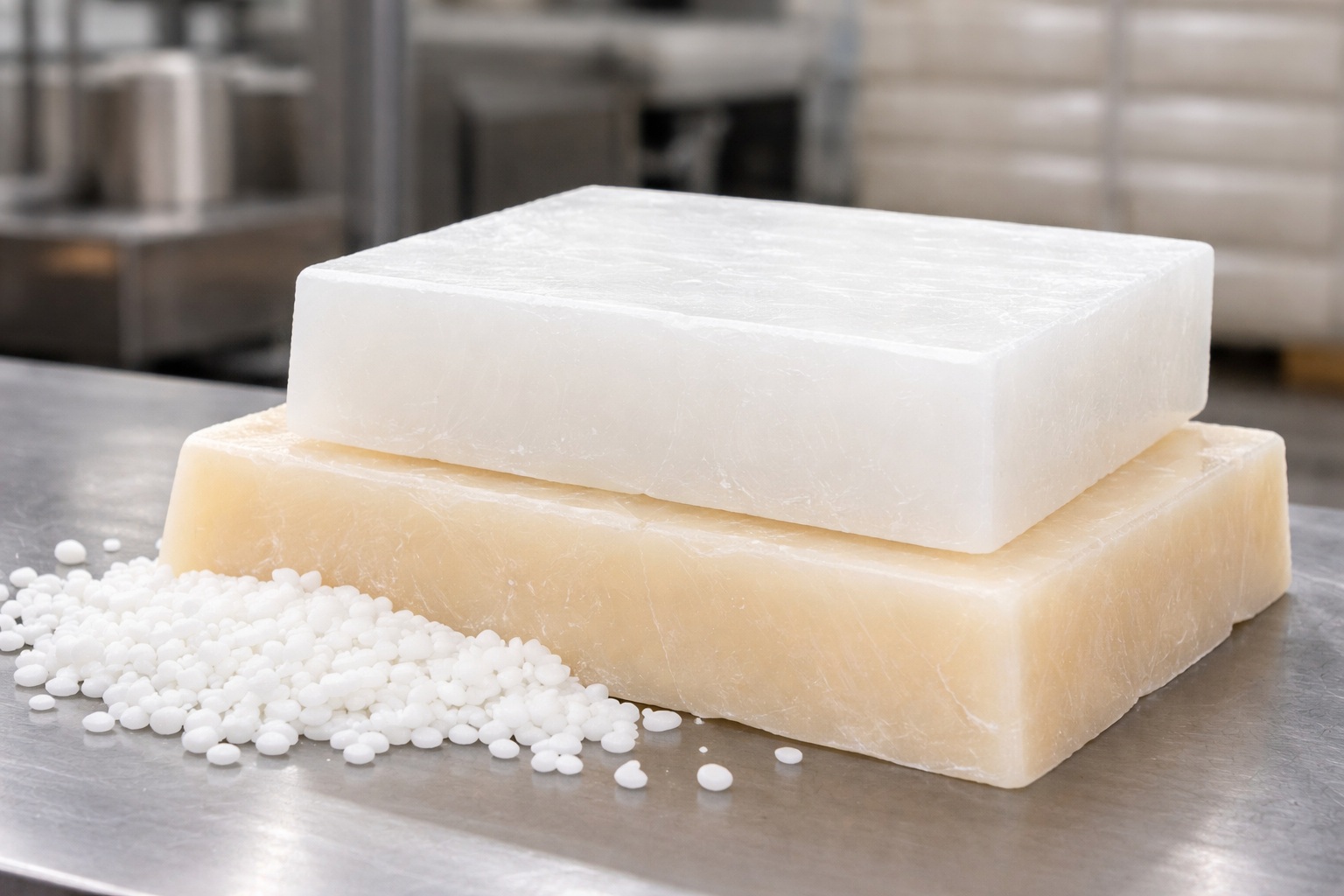
Paraffin wax is one of the most widely used by-products of the oil industry, consumed in candle making, packaging, rubber, cosmetics, pharmaceuticals and dozens of other industries. But how does this white, odourless material come out of thick black crude oil? In this article we explain the paraffin production process step by step, from the refinery to packaging, in plain language, and show how each stage affects the quality and price of the final paraffin.
What is paraffin and where does it come from?
Paraffin wax is a mixture of long-chain saturated hydrocarbons that is solid and waxy at room temperature. Its raw material is the heavy fractions obtained from distilling crude oil. In fact, paraffin is produced alongside base oil (engine oil and industrial oils): to make good base oil, the wax in the oil fractions must be removed, and this separated wax becomes paraffin after refining. To learn more about the different types, read Types of solid paraffin and their uses.
The paraffin production process, step by step
Step 1: Atmospheric and vacuum distillation
Crude oil is first heated in an atmospheric distillation column to separate the light fractions such as LPG, gasoline, kerosene and diesel. The heavy residue at the bottom goes into a vacuum distillation column. Distilling at low pressure lets heavy materials boil at lower temperatures without breaking down. The result is several oil cuts (light, medium and heavy), all of which contain some paraffin wax and are the main feedstock for paraffin production.
Step 2: Solvent extraction (removing aromatics)
The oil cuts contain large amounts of aromatic compounds that spoil the colour, odour and stability of the product. In this step, solvents such as furfural separate the aromatics from the oil. The output is called “raffinate”: a cleaner oil that still contains paraffin wax and is ready for the next step.
Step 3: Dewaxing and slack wax production
The raffinate is diluted with a solvent such as a methyl ethyl ketone (MEK) and toluene mixture and then gradually chilled. As the temperature drops, the wax molecules crystallise and are separated from the oil by rotary vacuum filters. The dewaxed oil goes to the base oil unit, and the separated wax, which still contains a considerable amount of oil, is called slack wax. Slack wax is the raw material for paraffin and is also used on its own in industries such as particleboard (MDF) and fertiliser.
Step 4: De-oiling
The most important difference between good and poor paraffin is its oil content. In de-oiling, the oil remaining in the slack wax is removed. This is done in two ways:
- Sweating: the older method, in which the wax is slowly warmed so that the oil and low-melting components “sweat” out of it.
- Solvent de-oiling: today’s common method, in which the wax is dissolved in solvent again, chilled and filtered. It is more precise and produces paraffin with a very low oil content.
The by-product of this step is a waxy oil called foots oil, which has many industrial uses. Based on the remaining oil content, paraffin is divided into two main groups:
- Semi-refined paraffin: slightly higher oil content; suitable for industrial uses and ordinary candle making.
- Fully refined paraffin: very low oil content (usually below 0.5%); whiter, harder and more odourless (like crystalline paraffin), suitable for food, pharmaceutical and cosmetic industries and high-quality candles.
Step 5: Finishing
De-oiled paraffin may still have colour, odour or minor impurities. In the finishing step, these are removed by one of the following methods:
- Hydrofinishing (hydrogen treatment): the paraffin is treated with hydrogen gas over a catalyst to remove the remaining sulphur, nitrogen and aromatic compounds. This method is common for food and pharmaceutical grade paraffin.
- Treatment with bleaching earth: molten paraffin is passed through a bed of adsorbent clay to remove its colour and odour.
The result is a paraffin that is white, clear when molten, odourless and stable.
Step 6: Grading by melting point and forming
The finished paraffin is graded by melting point, for example 52–54, 56–58, 58–60 and 60–62 °C. Each grade suits a particular use; for example, higher melting points are preferred for moulded pillar candles and lower ones for container candles (see the full guide in Choosing the best paraffin for candle making). The molten paraffin is then formed into different shapes:
- Slabs: blocks of a few kilograms, the most common form of solid paraffin.
- Granules and pastilles: small beads that are easier to melt and weigh.
- Molten (bulk): delivered by tanker to large industrial consumers.
Step 7: Quality control and packaging
Before sale, every production batch is sampled and tested to standard methods. The most important paraffin quality tests are:
- Melting point (ASTM D87) and congealing point (ASTM D938)
- Oil content (ASTM D721)
- Saybolt colour (ASTM D156); a higher number means whiter paraffin
- Hardness or needle penetration (ASTM D1321)
- Odour and, for food grades, compliance with food standards
Finally, the paraffin is packed in multi-layer bags or cartons and a certificate of analysis (COA) is issued for each batch.
How is liquid paraffin and paraffin jelly production different?
Liquid paraffin, unlike solid paraffin, is not made from waxes; it is produced from refined oil cuts that are deeply treated (by hydrogenation or acid treatment) to remove all aromatic compounds, giving a colourless, odourless and tasteless oil. Paraffin jelly (Vaseline) is a semi-solid blend of oil and microcrystalline waxes, produced mainly from the heavy residues of vacuum distillation and then refined.
What affects the quality and price of paraffin?
- Feedstock and crude oil type: some crude oils contain more and better wax.
- Oil content: the lower it is, the better and more expensive the paraffin.
- Finishing method: hydrofinished paraffin is worth more for sensitive uses.
- Melting point grade and form: slabs, granules or bulk.
- Order volume: buying paraffin in bulk directly from the producer lowers the cost.
Frequently asked questions about paraffin production
What is paraffin made from?
Paraffin is obtained from the heavy fractions of crude oil as a by-product of base oil production.
What is the difference between slack wax and paraffin?
Slack wax is crude wax that still contains a lot of oil; paraffin is slack wax that has been de-oiled and refined.
What is fully refined paraffin used for?
The food industry (such as coating cheese and fruit), pharmaceuticals, cosmetics, packaging and high-quality candles.
How can I check paraffin quality before buying?
Ask the seller for the certificate of analysis (COA) and compare the melting point, oil content and Saybolt colour with your requirements.
Buy paraffin from Mehr Gostar
Mehr Gostar Paraffin Refining produces solid, liquid and jelly paraffin as well as petroleum jelly and polyethylene, and supplies its products across Iran and for export. Visit the products page, read our paraffin buying guide, or contact our specialists for a quotation and certificate of analysis.
Related Mehr Gostar products
Submit a comment
No comments found


